Showing posts with label Orkney At War. Show all posts

Friday, 7 June 2019

Orkney After the Armistice - January to June 1919

The 14th (and final) instalment of our "Orkney at War" Exhibition series is now available to see in the Archive Public Searchroom under the new title of "Orkney After the Armistice - January to June 1919.
The display shows how Orkney and Orcadians were affected during the aftermath of the war and includes information about the German High Seas Fleet interned in Scapa Flow from November 1918 to the dramatic scuttling on 21st June 1919.
Items used are newspaper reports, town council minutes, photographs, school log books, and sections of books most of which were created at the time or just after.

Here are a few items from the main exhibition:

JANUARY

Extract from Rev. Dr. T Crouther Gordon's book Early Flying in Orkney - Seaplanes in World War 1:
"In the New Year's Honour's List of 1st January 1919, the Distinguished Flying Cross was awarded by HM King George V to Captain Macro, Lieutenant Guild and myself, and Lieutenant Sanderson got the Air Force Cross."
Dr T Crouther Gordon, pilot at Houton Seaplane Station, WW1

The Orcadian 2nd January 1919 p4

ZETLAND COUNTY COUNCIL AND NAVAL PERMITS
Reminder to Naval Authorities that War is Over
At the monthly meeting of the Zetland County Council, Mr Mouat said he was very glad to see that the Orkney papers had taken up the question of permits at Orkney. He thought this Council should take the necessary steps to have these restrictions removed at once. We have borne hardships and restrictions uncomplainingly, and they were now no longer required. There was still apparently no shortage of red tape.

He had travelled in the south and he was sure that no other county in Great Britain would have put up with the restrictions which had been placed on our travelling public. Passengers who were allowed to go about on the mainland freely could not be trusted to land at Kirkwall to have a meal ashore. The same hardships were imposed on soldiers and sailors who had been fighting for their country.

Last week, a month after the signing of the Armistice, he stepped onto the pier at Kirkwall in order to despatch some telegrams when a detective whistled on him. He replied that he would land and he did so and gave his telegrams to a gentleman to send off. He asked the detective if the naval authorities did not know that the war was over, but was told that the restrictions still applied. Mr Pottinger and he had just arranged to send a wire to the Admiralty requested them to inform the naval authorities at Kirkwall that the war was over and to allow passengers from Shetland to land, when a Customs official came on board and said a telegram had just been received stating that passengers coming and going to Shetland could land at Kirkwall.


FEBRUARY

The Orcadian 13th February 1919 page 5

THE MILITARY CROSS
A supplement of the London Gazette stated on February 1st, the award of the Military Cross is announced to Second Lieutenant T. W. Hepburn, Highland Light Infantry, attached 15th Battalion, for conspicuous gallantry and devotion to duty on September 5th 1918, at the crossing of the Somme. During the night he constructed a gangway on a broken bridge over the marshes under continuous machine-gun fire. He then crossed alone and reconnoitred the east bank of the river, the knowledge he gained resulting in the successful advance on to the ridge over the river by the company which he led. Lieutenant Hepburn is a son of Colonel Hepburn, Orkney Royal Garrison Artillery.

BAR TO MILITARY CROSS
Orcadians will be pleased to learn that Captain T N. F. Hourston, M.C. Argyle and Sutherland Highlanders, son of Mr and Mrs Hourston, Beaquoy Farm, Dounby, has now been awarded a bar to his Military Cross and mentioned in Sir Douglas Haig's New Year despatch. This honour was won during the fierce battle of September 29th - October 2nd crossing the St. Quentin canal near Joncourt.

The Orcadian 20 February 1919 page 4

REGENT STREET AT SCAPA FLOW - A Floating Shop for the Fleet
With the berthing of the steam ship Borodino in the Surrey Commercial Dock on Tuesday last week, it is now possible to make known a story which is without precedent in the history of the British Navy.
In December 1914, Commodore [Cecil] Lambert, the Fourth Sea Lord, conceived the idea that the monotony of life in the Grand Fleet, stationed at Scapa Flow, might be greatly relieved by giving the officers and men opportunities for obtaining the simple luxuries of everyday life, which, naturally, could not be obtained in the remote hamlets of the Orkney Islands. An arrangement was made with the Junior Army and Navy Stores, Lower Regent Street, [London] to take out a floating store, replete with every commodity that was likely to be required.
Officers and men of the Fleet were permitted to come aboard daily between 9 in the morning and 4 in the afternoon. These visits were usually productive of interesting incidents, and they were taken advantage of to an extent that the store was often overcrowded. On one occasion no fewer than 2,700 officers and men came to make purchases, and on another, when the American sailors boarded the SS Borodino in force the day's receipts amounted to £978. This turnover in the four years was at the rate of £10,000 per year.

PRINCE ALBERT'S VISITS
One of the frequent visitors was Prince Albert, and he invariably bought a shirt or collar. When he had made his purchase it was customary for him to say that the articles were for an other officer on board his ship. Prince Albert was a "snotty" with the Grand Fleet - a term which has been used in the Navy for young midshipmen since Nelson's day. Mr Allen, who was the first supervisor, stated that the prince was plain "Mr Johnson" to his companions. Occasionally when in the shopping centre the prince gave his orders in dumb show by putting his hands in his pockets and whistling. This was because the manager once laughingly said to him during a very busy time, "Now then, Johnson, no pilfering; whistle all the time till you're out of the shop, and keep your hands in your pockets till you are asked to pay. While you are whistling you can't eat anything, and you can't pinch anything with your hands in your pockets."


MARCH

The Orcadian 6th March 1919 page 4

LOCAL NEWS - SHIPPING MISHAPS
On Monday night an Admiralty Trawler when coming into Kirkwall collided with the steam fishing trawler R. H. Davidson. The latter vessel which was lying at anchor in the bay at the time, had her port quarter seriously damaged, and the cabin, which is aft, is full of water. The vessel was taken alongside Kirkwall Pier to have temporary repairs effected. A naval launch lying at the entrance to the Basin filled with water during the gale and sank. The launch was raised on Tuesday, but was found to be considerably damaged, owing to the "puffer" Borderglen, alongside which vessel it had been lying, canting over on to it taking the ground at low water.

The Orcadian 13 March 1919 page 4

DISTRICT NEWS - DEERNESS
Influenza is rife in the parish and very few households have escaped. One or other of the doctors from Kirkwall has been in the parish every day for a fortnight, and on one day the services of three medical men were required. From Sunday, 2nd to Saturday 8th inst.[of this month], eight deaths occurred. In several instances whole households have been suffering from the complaint at one time.


APRIL


At a meeting of the Stromness Town Council on the 12th April, the Town Clerk wrote:

Letters were submitted of 22nd March and 3rd inst. from the Naval Works Office, Stromness stating that Saw Mills had been vacated by the Air Force and on the subject of replacements required. The Town Clerk was instructed to write stating what was required in the way of reinstatement.
Extract from S1/5 Stromness Town Council Minutes 1910-1924


MAY


The Orcadian 8th May 1919 page 4

DISTRICT NEWS - SANDAY - DEMOBILISED SOLDIERS ENTERTAINMENT
All the demobilised soldiers were entertained by the ladies of the island on Friday night, in the Drill Hall. The entertainment, which was very enjoyable, took the form of a tea and dance. Mr Scott, in his address of welcome to the invited guests, spoke warmly of the services they had rendered during the great war, and in very touching words expressed the great debt the country owed to those who had made the supreme sacrifice. Mr Scott was then thanked for his address of welcome, and the soldiers were called on to give three cheers to the ladies of the island. This was responded to in real army fashion. Thereafter dancing was engaged in with great spirit for several hours, excellent refreshments being handed round at intervals.
Altogether it was a most enjoyable evening, and the invited guests take this opportunity of thanking their hostesses for the splendid arrangements they made, and also for their uniform kindness and generosity to the soldiers not only on this occasion, but throughout the long stress and strain. Special thanks are due to the ladies committee, consisting of:- Mrs MacPhail, Mrs Baillie, Misses Sinclair, Burgher, Wilson, Fotheringhame, Clouston, Muir, Moodie, Swanney and Skea. Splendid music was supplied by Messrs James and William Grieve, Melville, Fotheringhame and meil. The excellence of the tea was due to Miss Scott and Mrs Garrioch, and Messrs Fairbairn and Baillie did their upmost to make the entertainment an unqualified success. [Sadly the names of the demobilised soldiers were not listed in this article]


The Orcadian 15th May 1919 page 5

AMERICANS IN KIRKWALL
Most of the American minesweepers based at Kirkwall proceeded to sea last Saturday morning to commence the work of cleaning up the minefields. On Thursday night the opening concert was given in the YMCA Hut. The first portion of entertainment consisted of a performance by the band of USS Black Hawks, under bandmaster R. W. Wilson. The programme submitted highly delighted the large audience. The jazz band and a portion of the minstrel troupe enlivened the remainder of the evening with their witticisms, humorous songs and catchy music. On Sunday evening the Rev. G. W. Dalgleish, M. A. conducted a service in the YMCA Hut for the Presbyterian sailors of the American Fleet.

A further match in the baseball league has been arranged for Saturday afternoon in the Bignold Park. At the close of play, there will be four boxing bouts. Among those who will take part is Johnny Dougherty, a well-known London Professional boxer, now with the K. of C. [possibly the Knights of Columbus]

JUNE

THE GERMAN HIGH SEAS FLEET INTERNED IN SCAPA FLOW
German Fleet in Scapa Flow taken by Tom Kent Ref: TK4130

Extract from book Scapa and a Camera by C W Burrows:
"During the period of their internment, communication between the German ships and our own Fleet was restricted to a minimum, and no one from our own ships was allowed on board the interned vessels unless on duty of an urgent nature. The Germans were required to victual and store their own ships from Germany, coal and water only being supplied locally.
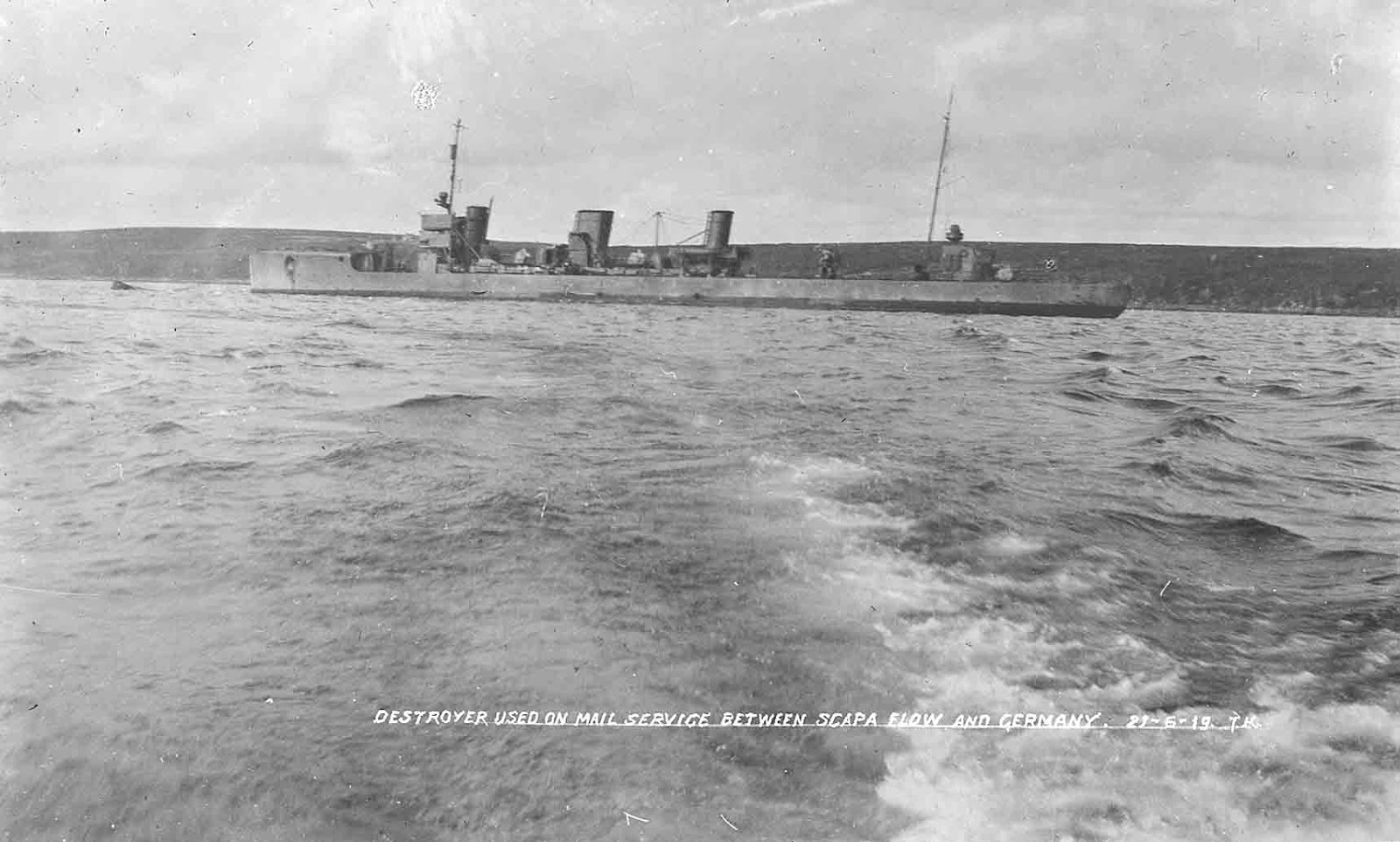
B98 Destroyer used on mail service between Scapa Flow and Germany
Ran aground in the Bay of Lopness, Sanday. Photo by Tom Kent Ref: TK4201
As German warships were not constructed for living aboard for long periods (the sailors being mostly accommodated in barracks when in harbour), the crews at Scapa must have had a rather unenviable time of it, though there was a certain element of poetic justice in interning them in the region where for so long our own Fleet had kept its lonely vigil. As one of their officers remarked in writing home and describing the bleakness and desolation of Scapa: "If the English have stood this for four years, they deserve to have won the war."
The German ships were patrolled by a number of drifters - a somewhat ignominious guard for the much-vaunted German Fleet.
The Germans' love of music was in evidence even at Scapa, and it was somewhat strange and at times rather pathetic to hear the unfamiliar strains of Die Wacht am Rhein and  Die Lorelei rising from the German ships, some which still retained their bands."
SCUTTLING - 21st June 1919
Stromness Public School Log Book (Infant School). Ref: CO5/93/5
"21st June: By kind permission of the Rear Admiral Commanding Orkney and Shetland, the pupils and teachers were conveyed by HMS Flying Kestrel to view the German Fleet in Scapa Flow.

Image of a tug which may be the Flying Kestrel Ref: L5128/4
They had the unique experience of seeing the Imperial German Ensigns flying at the mastheads, as their crews apparently by general agreement had made up their plans to sink them on this date. The crews were seen in small boats, pinnaces, rafts, etc.
By 4 p.m. only the Baden a light cruiser ashore on the West of Cava, and the turrets of the Hindenburg were to be seen from the School."

The turrets of the Hindenburg by C. W. Burrows Ref: L9522/3
The Orcadian 26th June 1919 page 4

STROMNESS SCHOOL CHILDREN'S THRILL
On Saturday afternoon, through the courtesy of the ACOS, the teachers and children of the Stromness School were taken through the lines of the German Fleet in the Flying Kestrel. Leaving Stromness about 10:30, they were able to see a good deal of what happened in the course of the day. The Flying Kestrel, after leaving Stromness, called at the battleships Baden, Kaiserin, Kaiser and Konig Albert, and then proceeded to visit the battle cruisers Derflinger, Hindenburg and Seidlitz. When the party reached the Seidlitz, my informant was surprised to notice that great preparations were being made to launch boats.

SIGNS OF EVACUATION
He observed that the crew were collecting large numbers of suit-cases and bags together. This was in the neighbourhood of 11 o'clock. The party went on to visit the destroyers, and there also seemed to be great preparations for a change or swapping of crews. The skipper asked the party of they would like to visit the hospital ships attached to the base. This was done... and the Flying Kestrel began to return to Stromness.

THE FIRST VESSEL SINKS
A drifter which was sailing towards the flagship shouted out that the German ships were sinking themselves. This was hailed with incredulity, but a vessel was suddenly seen to heel over beyond the north point of the island of Cava, turn bottom upwards and disappear. The journey towards home was continued, and the noticeable feature was the display of German Ensigns of the largest size on all the vessels.
German Cruiser SMS Bremse turned turtle. Ref: L6848/1

Pinnaces, small boats and rafts were seen in the water alongside the ships, filled or being filled with men. The ships began to sink deeper in the water, generally settling more quickly by the stern than by the bows. When the water reached the level of the deck at the stern,... the ship generally heeled over and turned bottom upwards. For sometime the hull remained above the surface, with steam pouring through vents in the bottom, but soon the hulls themselves disappeared.
Photo by C. W. Burrows Ref: L951/2
Men guarding sunken boat by Tom Kent Ref: TK4165

The children on board, more especially the younger of them, were greatly excited at the sight of the sinking vessels and the sight of men in the water, and in many cases were reduced to tears.
More Witnesses
G.H. Wild: 


Extract from p133 of Scapa Flow: The Story of Britain's Greatest Naval Anchorage in Two World Wars. by Malcolm Brown and Patricia Meehan. Available to see in the Orkney Room under reference 941.09 Y.

Hugh "Ti" David: "Yesterday at 9.45 the squadron with all destroyers at Scapa, put to sea for torpedo exercises - at 12.45 we received a wireless informing us that a German battleship was sinking - we turned and at full speed dashed back to Scapa - we got back at 3.30 and the sight that met our gaze as we rounded the Island of Flotta is absolutely indescribable. A good half of/


D1/1485 - Letter from Hugh David to this mother from HMS Revenge, 1919


 /of the German Fleet had already disappeared, the water was one mass of wreckage of every description, boats, carley floats, chairs, tables and human beings, and the 'Bayern' the largest German battleship, her bow reared vertically out of the water was in the act of crashing finally bottomwards, which she did a few seconds later in a cloud of smoke bursting her boilers as she went."

D1/1485 - Letter from Hugh David to this mother from HMS Revenge, 1919


A series of events will take place this weekend to commemorate the centenary of the Scuttling of the German High Seas Fleet. More information here https://www.facebook.com/scapa100/

Saturday, 15 September 2018

Orkney at War (July - December 1918)

The 13th instalment of our "Orkney at War" Exhibition is now available to see in the Archive Public Searchroom. [All images and text used in these exhibitions can now be seen in a folder in the Orkney Room]
The display shows how Orkney and Orcadians were affected by the war in their daily lives, using items from the Archive collections which were created at the time. Items such as newspaper reports, scrapbooks, council minutes, photographs, letters and diaries.

Here are a few items from the main exhibition:

From the Orcadian 4th July 2018:

"The New Voters Roll
Large Increase in Number of Voters
Over 1500 absent Voters on Orkney Roll
Compared with the register of voters, when last made up on 1st October 1914, the electorate has increased from 4414 to 11726 an increase of 7315.
As female voters account for 4568 of the total on the new list, male voters show an increase of 2747, or, excluding the 1547 men shown to be on active service, an increase of 1200."

Extracts from the Memoir of Bernard Williams (Archive ref: D1/526):

"The weather in July 1918 was perfect for this was the month that we embarked on the wooden 150 ton boat Minerva from Kirkwall to Pierowall Bay. It was as well that this boat was motivated by an eight horsepower combustion engine with a propeller with a 2 foot diameter, for if it relied on sail we should have been becalmed and stranded, this calm weather was unusual for the Orkneys.
When about to cast we had a distribution of letters and parcels from home. I well remember my packet contained a slab of Rowntree's plain chocolate which sustained me on this long sea epic to Pierowall, Westray Island, the most northern of the Orkney Islands [sic.] It was remarkable that Air Force authorities thought it not necessary to provide us rations until the end of this long sea journey. Of course the need for our visit to Westray was to make dawn attacks on U-boats that had become a menace to our shipping lines supplying food and arms to the Allied Forces and civilian population. The Minerva was already accommodating depth charges for this macabre mission of ours, also an Observation Balloon, also a 1 ton lorry with windlass and wire anchoring rope. They played a prominent part in spotting German submarines in the vicinity of the Northern Orkney Islands.
There was no slipway at Pierowall Bay so all loading had to be done by a rowing boat belonging to a Westray owner. The Minerva docked on the sea side of the pier at full tide. This, whether by fortune or guile of our intrepid pilot who charted us through this perilous venture, lessened the ordeal of unloading all our equipment. The lorry was removed first and was soon to be the first motorised vehicle to operate on the island of Westray. Only equestrian drawn traps and carts prevailed before
."


From John Fraser's Scrapbook, Archive Reference D1/692:


Letter to Willie Rendall from his mother about life in Kirkwall in July 1918. Part of the letter states that: "I can not get jam here today or Saturday as the Americans has been ashore on leave by the thousands and bought up everything we had".
Robert Rendall Papers D27/7/10

From book, Early Flying in Orkney by Dr. T Crowther Gordon: Extract from his day-to-day log book while stationed at Houton Air Station, Orphir. p20-21.
"The most exciting, dangerous and perplexing day of my whole career was Sunday 15th September [1918].
At 2.15pm I took off in F.3 4235 with Observer Harwood and flew at 1500 feet to squares 83, 84, and 95 in search of U-boats. When sixty miles out eat I decided to return to base with nothing to report, but the wind rose and low clouds obscured the Orkney Islands. I asked my navigator for my position, but he confessed he did not know. My engineer tapped me to draw my attention to the starboard engine. I was horror-struck. The petrol pipe was severed and more than half of the petrol was running along the outside of the exhaust pipe, which on an RR360 was very short. Flames flared from the inside of the exhaust while petrol ran along the outside. In a moment the whole machine could go down in flames and out of control. We were over a minefield; there was no ship small or large in sight. The revs dropped from 1400 to 400. The sea was rising. owing to low clouds no land was in sight. Four lives were at stake. One thing was clear to me: I would stay in flight for as long as the plane would fly.

Dr. T Crowther Gordon
On we flew and finally, plunging down through thick clouds, I levelled out to see just ahead of us the Horse of Copinsay, Holm Sound and the Flow. As the boat landed the starboard engine cut out completely. We were helpless but we were home. On examination the slipstream had kept the two broken halves of the petrol-pipe close enough to allow some of the fuel to pass into the engine and so keep the machine in the air."

From John Fraser's Scrapbook, Archive Reference D1/692:


From the Orcadian newspaper 19th September 1918 p7:

CAKES FROM CRUSTS OF BREAD

The urgent claims of coal economy make it imperative that baking days should be as infrequent as possible. But infrequent baking days have their disadvantages - among them numerous dry, stale crusts of bread which just before baking day comes round again accumulated remarkably fast. Bread does get dry nowadays!

Here is a good recipe for using up some of the crusts - and for making at the same time some excellent cakes for tea:-

Put the crusts of bread in a basin and pour boiling water on them. Meanwhile prepare a plain short pastry and line a number of small patty pans with it.

Drain away the water from the bread and beat with a fork. Add some dried egg beaten up with water, a little sugar, and if obtainable a few currants. If the currants cannot be had, flavour the bread mixture with ratafia.

Ratafia is a liqueur flavoured with almonds or the kernels of peaches, apricots or cherries.

From the Orcadian 14th November 1918, p4:

REJOICINGS IN KIRKWALL
The news of the signing of the Armistice with Germany was received in Kirkwall on Monday morning. The announcement was received with intense enthusiasm. The shipping in harbour, and the streets of Kirkwall were quickly bedecked with bunting, whilst the steamers in port voiced the feelings of all by the continuous sounding of sirens. All through the day the manifestations of joy continued; as ship after ship entered the bay, the glad tidings were announced to the mariners by renewed blowing of whistles.
On the recommendation of Provost Baikie, all places of business in the town were closed in the afternoon, and a joint service of thanksgiving, in which the ministers of the town took part, was conducted in St. Magnus Cathedral at night.

From John Fraser's Scrapbook, Archive Reference D1/692:

From the Orcadian newspaper 21st November 1918:

DISTRICT NEWS                                 FLOTTA
CELEBRATING "THE DAY" - The day on which the Germans signed the Armistice, which means peace, with glorious (if dear bought) victory for our side, was made memorable here by the blowing of their sirens for a long time, both in the forenoon and at night, by the "multitude" of vessels in the vicinity; by the hoisting of flags at prominent places, and by the ringing (by the minister himself) of the Parish Church bell. And now we will be looking for the early return of our dear ones who have "come through the war". Alas! That the general joy of meeting the living will be so much taken away from by the sorrow for those whom we will meet no more on earth. With every community in the empire, we thank God that the carnage has eventually ceased; and that it is hardly within the bounds of possibility that there will be another "world conflict" for generations to come.
Surrender of the German High Seas Fleet, November 1918:
It was actually November 1918 that the German High Seas Fleet came to Scapa Flow.

The German Fleet in Scapa Flow, Orkney

[All images and text used in these exhibitions can now be seen in a folder in the Orkney Room]. Click on "Orkney At War" in the labels to see more blog posts on this subject.
 
Dusty's first attempt at the 'Cakes from Crusts of Bread' recipe shown here at our Staff Christmas Party on the 8th December. They do look nice, but they were not very tasty, since the only sweet ingredient was the currants.  


Monday, 16 April 2018

Orkney at War (January-June 1918)

The 12th instalment of our "Orkney at War" Exhibition is now available to see downstairs on the blue carpeted wall in the Library (aka the Wavy Wall). [not between 5th-13th Sept 2018]
The display shows how Orkney and Orcadians were affected by the war in their daily lives, using items from the Archive collections which were created at the time. Items such as newspaper reports, scrapbooks, council minutes, photographs, letters and diaries.

Here are a few items from the main exhibition:

From Gunner Astles' Diary (Archive reference: D1/237): Gunner Astles was stationed at Hoxa Battery in South Ronaldsay and was a keen observer of his surroundings. His home county was Cheshire.

"Wednesday 2nd January 1918

The forenoon was very dull and a slight westerly wind prevailed. A little rain, but not much. About 2pm the wind changes to north and strong, with a very severe snap of Arctic weather in consequence. It was very cold, freezing hard and much snow fell, but very fine it was not long before the wind blew it all away from the camp.

Monday 28th January 1918

A funeral was on in the village, which in Orkney is never attended with women. The neighbours, friends and relatives follow behind and the body is conveyed in the hearse. The funeral passed us by and altho' but a few hundred miles away from home, we feel the change of custom.

The weddings here are also very peculiar to our own home. Invites are issued on the Monday and the deed is done on the following Thursday as a rule. The custom is carried out pretty well always and even engagements are entertained with dancing and merry making. In the village Cromarty hall, a large hall owned by a man in the name of Cromarty, is usually the rendezvous, and since I have settled here I have heard of several thus. The wedding usually takes place at night, kept up all that night, the next day perhaps, and the same night ends. A church ceremony is not necessary, a parlour, hall and even farm being appropriate for the person to join up the happy couple.

A farmer's cart is now outside the hut and, as we hear its usual noise of the wheels, "click-clack, click, click, clack", and a voice in the mess calling, "cart up" it again seems like old times, this being the first night for some time he has been able to bring up the meat, etc. from the village."

From Dr. Duncan's Scrapbook (Ref: D1/1127)

Private James Findlay, wounded in action.

From the Orcadian Newspaper, 12th Jan 1918 - No Light on Barrow

Before Sheriff Mercer at the Orkney Sheriff Court on Tuesday, William John Garden, representing the firm of R Garden Ltd, being the firm responsible for a message boy in charge of a barrow which contrary to the Defence of the Realm Regulation, carried no light on the night of December 15th last, tendered a plea of guilt to the charge.

The Sheriff said it was necessary that the order should be attended to, because in the darkened condition of the streets just now, the presence of vehicles of the kind set out in the charge might prove a serious danger to the public if not marked out by lights, and that was no doubt the reason for the passing of the order. The penalty in this case must be £1. The fiscal drew attention to the fact that a few barrows were carrying lanterns which did not show a red light to the rear, and he wished to point out that that was not a proper compliance with the Order. The Sheriff - it would be well if the public would note that the mere carrying of a light is not sufficient. There must be a lamp (or lamps) which besides showing a white light in front shows a red light behind. Albert Maxwell, merchant, Kirkwall, charged with a similar offence, in respect of his message boy, also tendered a plea of guilty, and the same penalty was imposed.

From Dr. Duncan's Scrapbook (Archive Reference: D1/1127):

Private Robert Sutherland, died of wounds

From Archive reference: D1/1062:
Programme for Grand Concert in aid of The Royal Marine Prisoners of War Fund, by The Hoxa Royal Marines.
From Dr. Duncan's Scrapbook (Archive reference: D1/1127):
Private James Burgess, fell in action.

From the Orcadian Newspaper, 2nd February1918 - Food Shortage

The food shortage is now becoming noticeable in Kirkwall. on Saturday night several butcher's shops were completely sold out early in the evening, and nearly every evening one or other have to shut before the normal closing hour. Butchers, of course, are now, in addition to observing the instructions in regard to meatless days, receiving only a proportion of the meat they have been able to dispose of for some time back. At present some difficulty is experienced in keeping the daily sales with proper limits, but the introduction of the meat rationing scheme, which is expected to be in operation shortly, will no doubt remedy this.

From Gunner Astles' Diary (Ref: D1/237): HMS Narborough & HMS Opal tragedy


[1st April 1918]
     During the Blizzard of January [12th] two destroyers ran aground some miles away from here [Hoxa Battery]. All hands were lost bar one. To-day I have been to see the wrecks, and a good deal of nature I saw.
     The wrecks are the scenes enacted one never hears of, but I should think it one of the greatest accidents in the Navy. For two destroyers crash on the rocks, hardly 50 yds from the cliff side, and then all hands to perish from shock and exposure, seems jolly hard lines in a place like it has happened in.

Able Seaman William Sissons was the only survivor [Photo ref: L1786/2]


The dilemma of the survivors must have been sad for the cold, blizzard raging, and the fact of the cliffs being covered in snow on a dark night must have been a very trying time before they expired.

From Stromness School Logbook (ref: CO5/93/5):

Transcription of a thank you letter from the King George V and Queen Mary to the children and teachers of Orkney

From John Fraser's Scrapbook (Ref: D1/692): Awards and Medals [exact dates are not always given for these entries, but they are in the later part of the book which suggests they occurred later in the war.]


Also included in the exhibition is a handbook on how to spot German submarines which was published in April 1918. This booklet was collected by Dr. T Crouther Gordon as research for his book, Early Flying in Orkney. All pages are on display, but here are just a couple of the pages as examples (Archive reference: D1/1017/5):

The 7th, 8th, 9th, 10th and 11th instalments are still displayed in various locations around the building and the 1st, 2nd, 3rd, 4th, 5th and 6th instalments, including a special feature of the sinking of HMS Hampshire, are available to see in a folder in the Archive Searchroom. Click on "Orkney At War" in the labels to see more blog posts on this subject.

Monday, 23 October 2017

Orkney At War (July - December 1917)

The 11th instalment of our "Orkney at War" Exhibition is now available to see upstairs on the Orkney Room corridor noticeboard.
The display shows how Orkney and Orcadians were affected by the war in their daily lives, using items from the Archive collections which were created at the time. Items such as newspaper reports, scrapbooks, council minutes, photographs, letters and diaries.

Here are a few items from the main exhibition:


L2153/1 Rousay
Territorials at the look-out hut on the Brae of Moan, Wasbister, Rousay. c.WW1. On the left is Corporal Isbister who was in charge. Back right is Marcus Wood from Aikerness, Evie.

JULY

From the Orkney Herald, 4th July 1917:

Band Performance
Band performances in Kirkwall have, since the outbreak of war, been, unfortunately, of rare  occurrence. On Saturday evening, however, the inhabitants were provided with a treat in the form of a band from one of HM's ships. Taking their stand in front of St Magnus Cathedral, a delightful two hours' orchestral concert was given, which was greatly appreciated by the great concourse of people who were present.

Letter to the Editor - The A.C.C. Concert in Kirkwall
Sir, - I notice with surprise in the last issue of your valuable journal the lengthy and somewhat favourable notice you give to the A.C.C. Concert held in the Temperance Hall.
I feel I am voicing the feelings of a large number of my fellow townsmen in raising a protest against this class of entertainment in Kirkwall. We were a quiet and pious community until invasion by men of the Fleet and Air Service was thrust upon us some time ago. We, of course, have no wish to grumble or complain of this, realising that it is unavoidable and for the good of the nation as a whole. We, however, can see no necessity for performances in our Temperance Hall which are a replica of those given nightly in the debauched music halls of London. The spectacle of an inebriated and vulgar person such as was depicted, was neither elevating or amusing, although, to be sure, the acting savoured more of the village idiot in this particular case. The sleek manner, glossy hair, and well-kept fingernails of the music hall manager, can only have a detrimental effect on our daughters, tending to make them dissatisfied with the homely lads at our doors, who are nearer and should be dearer.
[no name given]

Tragedy in Orkney Waters


From the Orkney Herald, 25 July 1917:

The Lost Vanguard
Was HMS Vanguard the victim of foul play?
The loss of this fine Dreadnought, which blew up while at anchor on the night of the 9th inst. as the result of an internal explosion, is to be the subject of a full inquiry.

According to the Admiralty statement, the Vanguard sank immediately, and unfortunately there were only three survivors on board, one of whom has since died. Twenty four officers and seventy-one men, however, were not on board at the time of the disaster, making the total number of survivors 97. The Vanguard had normally a compliment of 870, so it would appear that 770 men have perished.


L6569/2 HMS Vanguard
This is not, unfortunately, the first disaster of this kind which has occurred to the British Fleet (says Mr Archibald Hurd, the Daily Telegraph naval correspondent). On former occasions it has been suggested that possibly there had been foul play, but official assurances were given to soothe these fears.

In the meantime, however, the Stockholm revelations have been published, and we have learned of high explosives being made up to represent pieces of coal to be inserted in ship's bunkers. In the circumstances the public will await with anxiety the result of the official inquiry which will be held.

Apart from a sense of mourning the blowing up of the Vanguard will cause, the overwhelming thought for the moment will be that every precaution must be taken to prevent any further incident of this kind. The blowing up of a ship by internal combustion had become almost unknown in recent years. Since this war, however, such disasters have occurred to British, French and Italian ships, but, so far as is known, none had taken place in connection with German and Austrian Fleets.

AUGUST

From the Orkney Herald 8 August 1917:

The Orcadian Bed

Mrs J.W. Cursiter, formerly secretary of the Orcadian Women's Suffrage Society, has received the following letter from a wounded French soldier who has occupied the Orcadian bed at Royaumount:-

"Hospital de Royaumount, June 22, 1917 - Dear Mrs Cursiter, - I am very pleased to write to you after my stay at Royaumount in your comfortable bed, and after all the care which has been bestowed on me. I am proud to have shared in such boundless kindness, and glad that I am able to talk a little about what I saw in Britain, for I have spent several seasons there, particularly Newcastle-upon-Tyne.
And now I am going on leave to see my dear parents for the first time in five months. I would end my little letter by wishing you every happiness, and a paradise to come at the end of your life. - Your affectionate Ally, (signed) Jacob Jean Marie."

In WW1 over 18,000 charities were created to aid men at war and women and families at home in the UK. This included contributing to the upkeep of beds in hospitals.

SEPTEMBER

From the Stromness Town Council Minutes:

At a Meeting held on Thursday 27th September 1917

Stromness Town Council Minutes, ref: S1/5 p222
"The Council considered the matter of the navy carrying passengers gratuitously from Longhope to Scapa and elsewhere in consequence of which the trade of the town had been considerably hampered and the usual trading steamer "Hoy Head" had been placed at a considerable disadvantage. The Magistrates with Councillor Baillie were appointed to see the Master of the "Hoy Head" and have a letter written to the Admiral on the subject."

L3487/1 - Soldiers in Westray [names unknown]
 
OCTOBER
 
From the Kirkwall Town Council Minutes, K1/1/17 p512:
 
Meeting held on 17th October 1917
The following letter was read, "Paterson Manse, Kirkwall. 29th Sept 1917. Dear Mr Heddle, Will you kindly convey to the Provost, Magistrates and Councillors of the City and Royal Burgh of Kirkwall my sincere thanks for their kind message of sympathy in my great bereavement. The very beautiful Card on which their message is expressed will always be one of my most treasured possessions and will ever remind me of the years of our citizenship in Kirkwall, yours sincerely, [sgd] Agnes H. Millar"
 
NOVEMBER

Military Concert at the Drill Hall, St. Mary's Holm.

 
DECEMBER

Extracts from the Diary of Gunner Astles, Archive ref: D1/237

Hoxa Head Battery, South Ronaldshay, Orkney Is: N[orth] B[retain]

24th December 1917
The following notes are going to be chiefly on Orkney as I find it. I have been here over two years now, during which much has happened. Phenomena is in plenty, and it may look very odd at the weather results, later. Today has been mild, but 12pm has brought a great change, and now, as I write this, snow and hail is making Xmas feel ever so much nearer and seasonable.

Christmas Day, Orkney 1917
Christmas Day! The time of the Nativity. For the 4th year of the war, this has brought many comparisons as to the 1st, which I spent in the Red sea. I have been out for the greater part of the past night, and the morning was heralded by my pal, who it might be said, was anything but polite.
Wash over; hair brushed; immaculately attired in a blue jersey - as served out per Admiralty - and my pal and I sit down to dine.
Oh! What a feast. Two or three slices of bacon; a basin of tea; about eight loaves of bread; and ever such a long sit down, complete the menu, and as we are about the last to finish, a shrill whistle calls us out to Parade...
For my job I find myself in a party to draw water, which is to "bile douffs in" tis said...
11.30am the Christmas Dinner is brought: Pork; Potatoes; Cabbage; Apple-Ring Pie; Semolina Custard, and the dinner only needs putting out. One of the boys makes the gravy, calling it "Black Jack"...
A brisk walk of forty minutes lies before me... My way continued by way of the dam across the hill, and through the picturesque village of St Margaret's Hope...
"The Steamer" had arrived a few hours earlier...[it] is really the salvation here now-a-days. For many days the few shops have been empty of any seasons stores. Fruit and all such stuff has to be brought here, and...most commodities have become from luxuries to extravagances anywhere, but here, alas! all three have been at a premium.

The 7th, 8th, 9th, 10th and 11th instalments are still displayed in various locations around the building and the 1st, 2nd, 3rd, 4th, 5th and 6th instalments, including a special feature of the sinking of HMS Hampshire, are available to see in a folder in the Archive Searchroom. Click on "Orkney At War" in the labels to see more blog posts on this subject.