Monday, 10 December 2018

Peace On Earth - An Archive Advent Calender #10


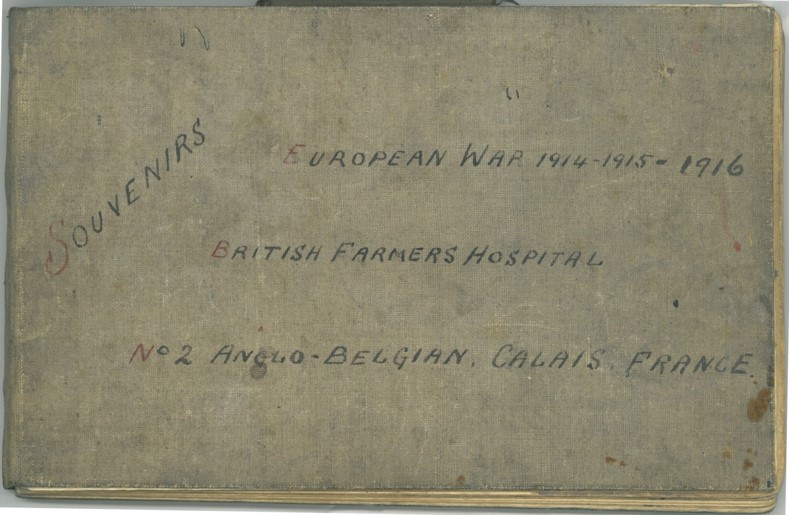
Today's archive is a souvenir/ autograph book containing drawings, poems and messages from patients of the British Farmers Hospital and the Number 2 Anglo-Belgian hospital, Calais, France from 1916 to 1918. It was handed in by the descendants of the nurse who compiled the book - Orcadian Lily Gunn.


Lily Gunn (left) and colleague at the front of the former Balfour hospital, now West End Hotel.


Click to enlarge

Orkney Archive Reference D1/983


A post card sent to Lily from Southampton.


Sunday, 9 December 2018

Peace On Earth 1918 - An Archive Advent Calendar #9

Another reminder that, although peace reigned in December 1918, war-time deprivations still applied. The Orkney Herald of the 4th of December 1918 carried the notice below urging people to stock up on woollens as 'pure woollen goods are practically unprocurable...owing to the great scarcity of wool for civilian purposes.'


I wonder why it was in such short supply?


Saturday, 8 December 2018

Peace On Earth 1918 - An Archive Advent Calendar #8


Impressively, a couple of months after the Armistice, the author of this poem makes a plea for feelings of civility towards the German nation whilst celebrating the coming of peace.


Orkney Herald - 1st January 1919.


Friday, 7 December 2018

Peace On Earth 1918 - An Archive Advent Calendar #7

See below for the 11th (and last) edition of The Concentrator: A Journal of the Land Defences, Scapa Flow. Published by and for the various servicemen and women stationed at various batteries around the flow, the (roughly) monthly journal contained articles both humorous and serious. There were news reports from the various batteries, correspondence, spoof adverts and poetry. The editors often struggled to obtain supplies of paper but, for the last year of the war, The Concentrator helped to rally spirits and spread news between colleagues.


Shelf reference 050Y in The Orkney Room

Click to enlarge.
 

Thursday, 6 December 2018

Peace On Earth 1918 - An Archive Advent Calendar #6

On this HIDEOUSLY dark and rainy winter's morning, let us think of the attendees of the social dance held at the No. 20 Balloon base at Caldale on Christmas day 1918. They planned to sing, dance, waltz and gallop the night away...


They ended their evening with a rousing rendition of God Save The King as I am sure you all plan to do on your Christmas nights out. The Orkney and Library Archive Christmas party both begins and ends with God Save the Queen but we also sing O' Flower of Scotland for balance, and then Dennis Waterson's I Could Be So Good For You because he makes us.


Click to enlarge

Orkney Archive reference D1/88/3


Wednesday, 5 December 2018

Peace On Earth 1918 - An Archive Advent Calendar #5

Todays blog is a collection of local adverts in the run-up to Christmas 1918. We are delighted by the mentions of cosy slippers and 'dainty, serviceable novelties' but deeply saddened (yet intrigued) at the thought of tea and coffee made with tablets.


Click to enlarge


Tuesday, 4 December 2018

Peace On Earth 1918 - An Archive Advent Calendar #4

Today's archive is a description of the children's Christmas concert held on the island of Flotta, taken from the Orkney Herald dated 1st of January 1919. Our favourite bit is of course "entertained to tea and plenty of good things therewith." In Orkney, a tasty cake or bake is always known as 'a good thing.'


Monday, 3 December 2018

Peace On Earth 1918 - An Archive Advent Calendar #3

Today's Christmas 1918 archive is taken from the Orkney Herald dated 18th December 1918:


Sunday, 2 December 2018

Peace On Earth 1918 - An Archive Advent Calendar #2

Following on from yesterday's post when we demonstrated that, although war was over, rationing was still in place for Christmas 1918, we are posting an extract from the local teaching union meeting minutes discussing a decision to strike.


Orkney Archive Reference D50/1/1 - Click to enlarge


There had been a lot of industrial unease in 1918 as can be seen from the newspaper snippet below. You will also spot a demobilisation order for teachers and students still far from home in December 1918.


Orkney Herald - 1st January 1919 - click to enlarge

Saturday, 1 December 2018

Peace On Earth 1918 - An Archive Advent Calendar #1

Merry Yuletide, dear readers. It is time to unveil to you our annual advent treat.


 There has been much Chrimbo tomfoolery in the past: Angry, betinselled statues in 2010, Time travelling celebrities in 2013, tormenting poor Killer-singer Seal in 2014, an archive advent calendar in 2016 and we tested you all with ridiculous quizzes last year.


This year, we thought that we would celebrate Christmas of 100 years ago - 1918. The Armistice had been declared and peace on earth was finally a reality. Join us over the next few weeks as we share some archives from that winter.


Our first archive addresses the fact that, although war was officially over, some war time realities still continued. Sugar was still rationed in December 1918 and one still had to produce a card like the one below to procure it:


Orkney Archive Reference D30/2/5


Christmas without loads of sugar? Fear not, the government announced that extra rations were available for the festive season. Phew.


Orcadian 5th December 1918


Saturday, 10 November 2018

Margaret Tait 100


Margaret Caroline Tait, Orcadian film maker, poet and medical doctor was born, one hundred years ago tomorrow, on the 11th November 1918 - Armistice Day.

Her family lived in a flat on Broad Street, opposite St Magnus Cathedral and so would have heard the ships honking in the harbour and seen the bunting bedecked streets from their window on that day.

Tait trained as a doctor in Edinburgh after primary schooling in Kirkwall and a secondary education in Edinburgh. She enlisted in 1943 and served with the Royal Army Medical Corps in the UK and the Far East where she began to write short stories.


Margaret Tait's Italian Student Matriculation Card with photograph dated 1947.
Orkney Archive Reference D97/1/6


After some time working as a locum doctor (and writing screenplays) in various parts of Britain, Tait travelled to Perugia in 1950 to research a film. She ended up abandoning the proposed film and instead enrolled at the Centro Sperimentale di Cinematografia film school in Rome for a two year course. This led to the formation of Ancona films with fellow student Peter Hollander.

Margaret Tait and Peter Hollander
Orkney Archive Reference D97/44/5


For the next 46 years, Tait worked under the banner of Ancona films, largely alone and in various Scottish locations, making short films which were partly funded by her continuing work as a locum. Books of poetry were also produced, short stories and a children's book. She made watercolours, wrote a novel and took photographs.

Watercolour design for film Painted Eightsome.
Orkney Archive Reference D97/44/2


In 1992, Tait finally directed her long gestated feature film Blue Black Permanent at the age of 72.


Continuity polaroids used during the filming of Blue Black Permanent.
Orkney Archive Reference D97/13


When she died at the age of 80 in April 1999, her husband Alec gifted several crates worth of letters, photographs, poems, screenplays, paintings, personal diaries, filming diaries, notebooks and personal documents to the library and archive. 48 boxes worth have been catalogued and are available to view.


Several items are currently on loan to GOMA in Glasgow, Summerhall in Edinburgh and Northlight in Stromness, all of whom are currently hosting exhibitions celebrating Margaret Tait's centenary. There is also a small display in the Orkney Room in the Orkney Library & Archive.

If you are unable to visit us in person, then please see below for more images from our exhibit and click here to watch her films.


Poster and ticket for the 1955 Rose Street Film Festival held in Margaret Tait's Edinburgh flat.
Orkney Archive Reference D97/23/1/19&20 


Storyboard for Blue Black Permanent
Orkney Archive Reference D97/26/8

Orkney Archive Reference D97/13


Thursday, 18 October 2018

A Free Man In Kirkwall

Orkney Archive Reference SC11/5/1826/66
For anti-slavery day we took a look through the catalogue to find the few mentions we remembered about Orcadian gentry who were either slave-owners in Jamaica or who made money from the slavery trade.

We found a court case from 1826 between David Erskine of Kirkwall and James Makewell, a former slave.

Erskine was claiming breach of contract against Makewell who, as he put it, 'had belonged' to his brother, Dr Robert Erskine of London who was referred to as Makewell's 'master'. Dr Erskine had visited his brother in Orkney, leaving Makewell behind when he returned home.

David Erskine claimed that he had fed and clothed Makewell and sent him to school whilst waiting for his brother to send for his servant. When no word came, he alleged to have offered Makewell employment at the rate of £3 per year, half of which he said was paid upfront.

Makewell was then apparently 'induced' by John Traill Urquhart of Elsness, to join him as his servant in Sanday despite Urquhart being previously warned off by Erskine.


This version of events was roundly disputed by Makewell who averred that 'the moment he arrived in Britain, his slavery ceased, and he became equally free as the petitioner himself.'

He agreed that he had been left behind in Orkney by his former employer, but not that he had been treated well nor truly engaged in formal employment by his Kirkwall host. He described being fed but not clothed, ending up in nothing but rags, whilst being forced to work as a farm labourer, something which he had no training for.

His version of the events had him deciding that he had been patiently uncomfortable for long enough and that he had to do 'something for himself' which led to employment as Urquhart's servant.

He rejected the idea that he had been paid £11/2 as a retainer for the rest of the year and claimed that he had been handed 10 shillings for clothes towards the end of his stay with Erskine and a further 20 shillings before he left. This, he said, was remuneration for all the work he had done thus far rather than a new wage. 'The alleged engagement was altogether imaginary' in his opinion.


David Erskine hit back at this representation, calling it 'ungrateful' and 'uncandid'. He reiterated that he had put Makewell through school which apparently took up much of his time and called the idea that he had made Makewell work as a labourer 'absurd' as he did not have a farm, merely a 'park' which Makewell had 'taken a fancy' to ploughing one day.
Click to enlarge

Unfortunately, our Sheriff Court papers do not record the outcome of this case, but the last item in the bundle states that the Sheriff Substitute 'allows the petitioner [David Erskine] a proof of his averment of the engagement under which he claims the respondent's [James Makewell's] services and for that effect grants diligence against witnesses to be reported the day of...[left blank].

I'm not sure if this means that the Sheriff Substitute was ruling in Erskine's behalf or whether he was merely giving him more time to prove that he had engaged Makewell in his employ.

Can any lawyers help??

(Some lawyers did help... see the comments section below...)

Thursday, 4 October 2018

Happy National Poetry Day

Published poetry collections can be found in the Orkney Room


Regular Radio Orkney listeners will have heard poems by Margaret Tait being read out every day this week in honour of National Poetry Day.


Not heard of Margaret Tait? Simply click here to see our previous blog posts, click here to listen again to Radio Orkney's morning broadcasts and click here to watch her films.


The Orkney Library and Archive hold Margaret Tait's archive of poems, correspondence and working papers and we also keep published copies of her collections of poetry. Those of you who are already fans may wish to read unpublished poems from her collection as well as her many working diaries made during filmshoots and peruse the lovely watercolour paintings which were recently shown at the Pier Arts Centre.


Manuscript of Origins and Elements, Orkney Archive reference D97/46/2/3/1

Manuscript of The Hen and the Bees, Orkney Archive reference D97/46/2/3/2
 
Unpublished writings, Orkney Archive reference D97/46/2/1


D97/44/2/23


Saturday, 15 September 2018

Orkney at War (July - December 1918)

The 13th instalment of our "Orkney at War" Exhibition is now available to see in the Archive Public Searchroom. [All images and text used in these exhibitions can now be seen in a folder in the Orkney Room]
The display shows how Orkney and Orcadians were affected by the war in their daily lives, using items from the Archive collections which were created at the time. Items such as newspaper reports, scrapbooks, council minutes, photographs, letters and diaries.

Here are a few items from the main exhibition:

From the Orcadian 4th July 2018:

"The New Voters Roll
Large Increase in Number of Voters
Over 1500 absent Voters on Orkney Roll
Compared with the register of voters, when last made up on 1st October 1914, the electorate has increased from 4414 to 11726 an increase of 7315.
As female voters account for 4568 of the total on the new list, male voters show an increase of 2747, or, excluding the 1547 men shown to be on active service, an increase of 1200."

Extracts from the Memoir of Bernard Williams (Archive ref: D1/526):

"The weather in July 1918 was perfect for this was the month that we embarked on the wooden 150 ton boat Minerva from Kirkwall to Pierowall Bay. It was as well that this boat was motivated by an eight horsepower combustion engine with a propeller with a 2 foot diameter, for if it relied on sail we should have been becalmed and stranded, this calm weather was unusual for the Orkneys.
When about to cast we had a distribution of letters and parcels from home. I well remember my packet contained a slab of Rowntree's plain chocolate which sustained me on this long sea epic to Pierowall, Westray Island, the most northern of the Orkney Islands [sic.] It was remarkable that Air Force authorities thought it not necessary to provide us rations until the end of this long sea journey. Of course the need for our visit to Westray was to make dawn attacks on U-boats that had become a menace to our shipping lines supplying food and arms to the Allied Forces and civilian population. The Minerva was already accommodating depth charges for this macabre mission of ours, also an Observation Balloon, also a 1 ton lorry with windlass and wire anchoring rope. They played a prominent part in spotting German submarines in the vicinity of the Northern Orkney Islands.
There was no slipway at Pierowall Bay so all loading had to be done by a rowing boat belonging to a Westray owner. The Minerva docked on the sea side of the pier at full tide. This, whether by fortune or guile of our intrepid pilot who charted us through this perilous venture, lessened the ordeal of unloading all our equipment. The lorry was removed first and was soon to be the first motorised vehicle to operate on the island of Westray. Only equestrian drawn traps and carts prevailed before
."


From John Fraser's Scrapbook, Archive Reference D1/692:


Letter to Willie Rendall from his mother about life in Kirkwall in July 1918. Part of the letter states that: "I can not get jam here today or Saturday as the Americans has been ashore on leave by the thousands and bought up everything we had".
Robert Rendall Papers D27/7/10

From book, Early Flying in Orkney by Dr. T Crowther Gordon: Extract from his day-to-day log book while stationed at Houton Air Station, Orphir. p20-21.
"The most exciting, dangerous and perplexing day of my whole career was Sunday 15th September [1918].
At 2.15pm I took off in F.3 4235 with Observer Harwood and flew at 1500 feet to squares 83, 84, and 95 in search of U-boats. When sixty miles out eat I decided to return to base with nothing to report, but the wind rose and low clouds obscured the Orkney Islands. I asked my navigator for my position, but he confessed he did not know. My engineer tapped me to draw my attention to the starboard engine. I was horror-struck. The petrol pipe was severed and more than half of the petrol was running along the outside of the exhaust pipe, which on an RR360 was very short. Flames flared from the inside of the exhaust while petrol ran along the outside. In a moment the whole machine could go down in flames and out of control. We were over a minefield; there was no ship small or large in sight. The revs dropped from 1400 to 400. The sea was rising. owing to low clouds no land was in sight. Four lives were at stake. One thing was clear to me: I would stay in flight for as long as the plane would fly.

Dr. T Crowther Gordon
On we flew and finally, plunging down through thick clouds, I levelled out to see just ahead of us the Horse of Copinsay, Holm Sound and the Flow. As the boat landed the starboard engine cut out completely. We were helpless but we were home. On examination the slipstream had kept the two broken halves of the petrol-pipe close enough to allow some of the fuel to pass into the engine and so keep the machine in the air."

From John Fraser's Scrapbook, Archive Reference D1/692:


From the Orcadian newspaper 19th September 1918 p7:

CAKES FROM CRUSTS OF BREAD

The urgent claims of coal economy make it imperative that baking days should be as infrequent as possible. But infrequent baking days have their disadvantages - among them numerous dry, stale crusts of bread which just before baking day comes round again accumulated remarkably fast. Bread does get dry nowadays!

Here is a good recipe for using up some of the crusts - and for making at the same time some excellent cakes for tea:-

Put the crusts of bread in a basin and pour boiling water on them. Meanwhile prepare a plain short pastry and line a number of small patty pans with it.

Drain away the water from the bread and beat with a fork. Add some dried egg beaten up with water, a little sugar, and if obtainable a few currants. If the currants cannot be had, flavour the bread mixture with ratafia.

Ratafia is a liqueur flavoured with almonds or the kernels of peaches, apricots or cherries.

From the Orcadian 14th November 1918, p4:

REJOICINGS IN KIRKWALL
The news of the signing of the Armistice with Germany was received in Kirkwall on Monday morning. The announcement was received with intense enthusiasm. The shipping in harbour, and the streets of Kirkwall were quickly bedecked with bunting, whilst the steamers in port voiced the feelings of all by the continuous sounding of sirens. All through the day the manifestations of joy continued; as ship after ship entered the bay, the glad tidings were announced to the mariners by renewed blowing of whistles.
On the recommendation of Provost Baikie, all places of business in the town were closed in the afternoon, and a joint service of thanksgiving, in which the ministers of the town took part, was conducted in St. Magnus Cathedral at night.

From John Fraser's Scrapbook, Archive Reference D1/692:

From the Orcadian newspaper 21st November 1918:

DISTRICT NEWS                                 FLOTTA
CELEBRATING "THE DAY" - The day on which the Germans signed the Armistice, which means peace, with glorious (if dear bought) victory for our side, was made memorable here by the blowing of their sirens for a long time, both in the forenoon and at night, by the "multitude" of vessels in the vicinity; by the hoisting of flags at prominent places, and by the ringing (by the minister himself) of the Parish Church bell. And now we will be looking for the early return of our dear ones who have "come through the war". Alas! That the general joy of meeting the living will be so much taken away from by the sorrow for those whom we will meet no more on earth. With every community in the empire, we thank God that the carnage has eventually ceased; and that it is hardly within the bounds of possibility that there will be another "world conflict" for generations to come.
Surrender of the German High Seas Fleet, November 1918:
It was actually November 1918 that the German High Seas Fleet came to Scapa Flow.

The German Fleet in Scapa Flow, Orkney

[All images and text used in these exhibitions can now be seen in a folder in the Orkney Room]. Click on "Orkney At War" in the labels to see more blog posts on this subject.
 
Dusty's first attempt at the 'Cakes from Crusts of Bread' recipe shown here at our Staff Christmas Party on the 8th December. They do look nice, but they were not very tasty, since the only sweet ingredient was the currants.