Monday, 9 December 2019

20 Days of Orkney Trees #7


In 2003, Orkney tree planting expert Jenny Taylor was asked about the then make-up of woodlands in Orkney. She gave the overall area of 105 hectares which was accounted for by 10 hectares of native woodland, 18 acres planted by the forestry commission in in the 1950s, 5 hectares planted on Flotta, 25 recently planted hectares and 47 hectares of woodlands planted pre-1920s around big estate houses such as Binscarth, Crantit, Papdale and others.


Binscarth woods is perhaps the most noticeable of these Victorian-era plantations. It is thought that the trees, which are visible from the Kirkwall to Stromness road in the parish of Firth, were planted soon after the building of Binscarth house in 1850 by owner Robert Scarth. The woodland was used for entertaining and leisure. Servants who worked at the house have told researchers about having to carry every single piece of a silver tea set into the woods so that the gentlefolk could have tea under the trees.


This section of 1882 Ordnance Survey map shows the spread of the woods by that date:


The picture at the head of this post was taken in the 1920s and was found in an album of photographs which were found in a skip! (A skip!) Thankfully, a passer-by fished it out and brought it to the photographic department to be lovingly copied and catalogued.


In 1952, the Orcadian dated 17th January tells us that hundreds of Binscarth trees were uprooted by the fierce storm of that year and the final number has been suggested to be 2,000. The next week's edition showed some of the damage:


The woods have been added to since by great, great grandson of Robert Scarth, Major Malcolm Macrae, who planted 2,500 trees in 1990 and a further 'shelter belt' in 1995. Tree varieties include sycamore, Swedish whitebeam, Sitka spruce, mountain ash (rowan) and larch.

The woodlands are no longer just for the use of the owners and are frequented by walkers, naturalists and school groups who greatly enjoy exploring the now well-established trees.

'Immediately a new world of green gloom received us, different to anything else in the islands. We were moving now through an intimate sylvan world, and the sense of space and light felt elsewhere in Orkney, was lost. But this new green world was not hostile. Rather the contrary. The brutality of nature, the vast forces of energy and ruthlessness which can be felt even on a peaceful afternoon at the top of a sea crag, were in this woodland muted and softened to a delicate gentle beauty. It was a world of silence and soft whisperings. The same kind of sacred gloom pervades the interior of St Magnus Cathedral'

Binscarth Wood by George Mackay Brown - Taken from Northern Lights, A Poet's Sources


Information taken from:


Orkney's Growing Green by Alan Hodge, Living Orkney #9
Orcadian newspaper.
Orkney Archive Reference D70/2/3 The History of Tree Plantations in Firth, Marie Sinclair
Orkney Archive Reference D70/7/16 A Brief History of Orkney’s Trees.  Alex Pendry.

Saturday, 7 December 2019

20 Days Of Orkney Trees #6

Like much of Britain, Orkney used to have far more trees. It is thought that the islands were covered in woodlands but, around 5000 years ago, they began to disappear. Two things happened at around the same time; climate change leading to stronger winds and human Neolithic inhabitants.


Whether the trees and shrubs of Orkney were too battered by the strong, sea winds, or chopped down for fuel or gnawed by domesticated, grazing animals, the woodlands disappeared.


So how do we know they were there in the first place? Because they are still here. Orcadian naturalists discovered this awhile ago:


'...it is observable in many places, even under the flat sea-beech, where the storms or other accidents wash off the gravel or sand, that black peat-moss, stuck through with trees, seems to have been the original soil. Sometimes a whole tree has been found, and the smallest fibre so strong as to bear lifting. And in a peat-moss in Deerness, at the depth of four feet, roots of trees and hazelnuts have been dug up, the nuts quite entire. This would seem to indicate, that the country was not formerly as it is now.'


(St Andrews and Deerness parish entry in the Statistical Account of Scotland 1791-1799)


'There are a number of sunken sea beaches in Orkney where roots of trees are found in situ below the water mark'

'They had been laid bare by a Westerly gale but were still embedded in hard, black peaty substance below the sea'

(letters written to Old-Lore Miscellany IV, 1912)


'On the west coast of the Mainland of Orkney, about midway between Hoy mouth and the Westray Frith lies the Bay of Skaill... Mr Watt of Skaill, discovered, during the ebb, what was apparently a peat-moss, about an acre in extent. Partly embedded, and lying on the surface of this moss, in a horizontal position, were the stems of several small trees about 10 feet in length, and from 5 to 6 inches in diameter. They were in a very decayed state; but a piece of one of them was so fresh, that Mr Watt was able to ascertain it to be some kind of fir.'


(Notice Regarding the Submarine Remains of a Grove of Fir Trees in Orkney, Edinburgh Philiosophical Journal 1820.)


'We first dig through a layer of sand, from one to two feet in depth, and then reach a bed of moss, in which the decaying skeletons of trees lie in every conceivable position. It is a melancholy sight to look into the open grave of what had at one time been an umbrageous forest, blooming in all the sylvan beauty of stately trunk, spreading bough, and green leaves, where beasts roamed and fair birds sang.'


(The Encroachment of the Sea - paper read to the Orkney Natural History Society in 1893. by Walter Traill Dennison)


'I stood six feet down and heaved out the buried past of the earth. It was cold, as if the last of the ice-age lingered; and here were leaves in a perfect state of preservation, autumn-tinted, veined and with stems attached; tiny red seeds, and one lovely green glinting thing that could have been an insect wing-case or a scrap of alien flora. The peat broke across at the leaf-layer, and right at the bottom, bedded in the blue boulder-clay, were tree branches and twigs.'


Bessie Skea in A Countrywoman's Calendar, 1962


When organic matter is squished down into soggy, anaerobic conditions, peat is formed. Much of Orkney is covered by thick layers of peat and, in the absence of timber to burn, this was often used as a fuel.


Cutting peats.


Carrying peats


Peat is a kind of natural archive, preserving layers of pollen, organic matter and evidence of climatic conditions. The pollen found in Orkney peat suggests the presence of wide areas of woodland scrub after the Ice Age. Trees like aspen, downy birch, rowan, hazel, juniper and willow thrived alongside roses and honeysuckle shrubs.


So if you are ever stepping across a springy peat bank just think, you could be walking over ancient, submerged forests.

Scientists are still examining these marine woodlands as you can see here: https://www.scotsman.com/lifestyle-2-15039/archaeologists-survey-scotland-s-forests-under-the-sea-1-4672611


Information taken from:

Growth in Britain's Most Northerly Wood by Chapman and Crawford, 1981
The Encroachment of the Sea by Walter Traill Dennison
Old-Lore Miscellany Volume IV
The Statistical Account of Scotland 1791-1799

Friday, 6 December 2019

20 Days of Orkney Trees #5

An older archive today, which illustrates how important trees can be for shelter...


click to enlarge
In 1769, three men were taken to Kirkwall Sheriff Court by Robert Grahame of the Breckness Estate, Skaill, for the 'pulling of Bent or Broom or Juniper' which were 'the natural fence of the adjacent countree (sic) to the said hills'


It was alleged that George Moar, Thomas Linklater and James Hackland, all servants to local landowners, 'did upon the 8th day of June... go to the said hill and there cut and destroyed the surface or scree of the said hill with (?) or hoes, spades or other instruments.'


Without the protection of the juniper fence, Robert Grahame was worried about sand from the nearby bay of Skaill being blown across his lands. He was seeking £5 in damages and a further £5 in legal costs from each defendant. That was a lot of money in those days.


George, Thomas and James did not deny the crime and had to pay 10 shillings each in legal costs. They also had to spend 3 days in Kirkwall tollbooth, i.e., the town JAIL.


This sentence was hung upon the door of the local church so that 'no-one (could) pretend ignorance.'


Crumbs.


The sentence.


There is no mention of what the men took the juniper for. The tree is known in Scottish folklore for warding off devils and witches, but you can also make gin from it. You can also carve it or burn it to smoke food.

Archive Reference: SC11/5/1769/7
Information taken from the Woodland Trust website.


Thursday, 5 December 2019

20 Days of Orkney Trees #4

Our last post showed an image of trees being planted for St Magnus Cathedral's Octocentenary. Eagle-eyed readers will have noticed some trees already in the background of the photos.

We found these earlier, rather fabulous, images of Provost Slater and other dignitaries planting trees in their full Council regalia and we thoroughly approve.


Any captions for these photos will be heartily welcolmed and added to this post and we may even send a sweetie (possibly pre-licked) to the reader who makes us laugh the most.

We do not have a definitive date for these photographs but they must pre-date 1936 as they were taken by Tom Kent and they probably date post 1925 as that is when John M. Slater became Provost of Kirkwall.

But what about the trees in the background of these images???? We have also found some articles from the Orkney Herald newspaper discussing trees in the Willows in 1922:


Wednesday, 4 December 2019

20 Days of Orkney Trees #3

Our last post was about the Norwegian gift of a tree which graces Kirkwall's Cathedral every Christmas. The tradition originally began in 1987, the year of St Magnus Cathedral's 850th anniversary.


50 years previous to this, some trees were planted in the Willowburn area of the town to commemorate the building's Ocotocentenary:


Anyone familiar with the Willows wood will be surprised to see them in such a sparse state. Now, the burn is surrounded by mature trees, many of which are home to crows and surrounded by flowers in the Springtime.


This photo, taken by Dougie Shearer in the early 1980s, shows how full the trees became. Many are sycamores, like the Big Tree of Albert Street.


These aerial photographs, also by Dougie Shearer, show how many leafy tree tops were bubbling up between Kirkwall's buildings by the latter part of the 20th Century:


Tuesday, 3 December 2019

20 Days of Orkney Trees #2

Yesterday, we wrote about Kirkwall's Big Tree and today we shall tell you about another important Kirkwall tree.


Every year, a tree is cut down in Bringsværd Forest, near Grimstad in Norway, and is brought to Kirkwall Cathedral as a symbol of friendship between the two towns.


This tradition began in 1987:


Orcadian 12th November 1987


Saint Magnus Cathedral was founded by Kali Kalason, later to become Rognvald, nephew of St Magnus. Young Kali grew up in Norway and perhaps played in the woods which would later provide Kirkwall with our Christmas 'big tree'.

I want you to make a vow... you'll build a stone minster at Kirkwall more magnificent than any in Orkney, that you'll have it dedicated to your Uncle the holy Earl Magnus and provide it with all the funds it will need to flourish.

St Rognvald's father, Kol Kalasan to his son in the Orkneyinga Saga


and you can see Orkney Islands Council convener Harvey Johnston cutting down this year's tree here: https://theorkneynews.scot/2019/11/12/orkney-norway-friendship-marked-with-2019-christmas-tree-cutting-in-bringsvaerd-forest/ (Mr Johnston does somewhat undermine the whole thrust of our advent theme by saying 'Orkney has no trees' in the article. Grrrrrrrr.)

Information taken from Orkney-An Illustrated Architectural Guide and an article in edition #73 of Living Orkney, both by Leslie Burgher.

Monday, 2 December 2019

20 Days of Orkney Trees #1

Oh we love advent readers!
We love it!
We LOVE it!


This year, we bring you 20 Days of Orkney Trees. Every day until Christmas (except Sundays), we shall prove that, contrary to popular belief, Orkney DOES have trees. Like, at least 5 or so?


The Orkney Isles (with the exception of hilly Hoy), are relatively flat with both wind and rabbits proving a challenge to hopeful tree-planters but, as you shall see, there are many wonderful sylvan corners; some ancient, some Victorian and a great many newer additions.


We just have to start with one tree. THE tree of Kirkwall, known by all as 'The Big Tree'.


The photo above was taken by Tom Kent and shows that the large Sycamore stands right in the middle of the shopping street. It had originally been part of a walled garden as can be seen below...


...and when the wall was removed, the tree stayed.


The Big Tree protected by a cage.


Over the years, there has been much discussion of this hardy plant and it has been threatened with destruction many times. Indeed, its obituary has already been written by Ernest Walker Marwick:


Click to enlarge


 In 1875, T. H. Slater demanded that the council prune the branches on his premises' side 'to avoid litigation and by way of compromise'. The council agreed:


As recently as 1987, there was a council meeting held to discuss its removal but a decision was reached to pollard it instead. The Big Tree still stands in Albert Street, Kirkwall, having outlived the author of its obituary by over 40 years. There is a large metal pole through its trunk, but it still stands tall and surely contributed to the High Street winning the 'most beautiful in Scotland' accolade last month: https://www.bbc.co.uk/news/uk-scotland-north-east-orkney-shetland-50521432

Information taken from Kirkwall Town Council minutes dated 3/2/1875,
Orkney Archive reference D31/73/1and
Orkney County Council minutes dated 6/10/1987.


Monday, 28 October 2019

Orkney Witchcraft Trial Source Books and Archives

The archive sources listed below are from the collections of Orkney historians and archivists of the past. Without the dedication of these people, the following items would not have been saved.  
The published sources in the Orkney Room have been collected for this room by all our Librarians of the past and present. Many thanks to them too.
We owe all of these people a huge debt of gratitude. All archive and published sources mentioned below are available to see in the Orkney Library and Archive.

Orkney Council Records Collection (Reference CO1)

An entry in the Commissioners of Supply minute book of 1669. The Commissioners of Supply were first established in 1667 for collecting the cess or national land tax. The commissioners were landowners charged with collecting the tax from their fellow landowners. But they also acquired duties which ranged beyond the collection of land tax and with the justices of the peace were responsible for county roads, bridges and ferries.
CO1/1/1 - Orkney Commissioners of Supply minute book, 1660-1678 

Item 6 on the above page reads:
"to procure a warrand from the Counsill to the Justicia and Justices of his Maj[es]ties Pease; for putting of Witches and Incestuous persons to a Triall."
Item 6

Ernest Walker Marwick Collection (D31)

Ernest W Marwick (1915-1977), was an author, journalist, broadcaster, historian and folklorist. He researched and collected a large amount of information on those who were accused of witchcraft in Orkney. Here is an image summing up his findings in a single page.

Summary Sheet (Reference: D31/4/3)
His subsequent article Northern Witches was published in the book "An Orkney Anthology" in 1981 and is available to see in the Orkney Room under reference 800 Y MAR

Cover of "An Orkney Anthology"
Beginning of article Northern Witches from pages 333-383 in An Orkney Anthology

About book and the author

A scribbled note from the Ernest Marwick Collection refers to Peterkin's Rentals of Orkney which lists some women as witches in the rental of 1595. This book can be seen in the Orkney Room under reference number  333 Y. The last one in the list says "Jonet of Cara quha was brunt for witchcraft" (Janet of Cara who was burnt for witchcraft).
Extract from EWM Collection Ref: D31/52/6/2

Extracted references from
Peterkin's Rental 1595

A list typed by Ernest Marwick of 8 questions put to Barbara Boundie led me to the original Orkney Presbytery minute book entry of 1643 in which all ten questions put to her can be read. The handwriting shown in this presbytery book on page 256 is surprisingly legible for the time period.
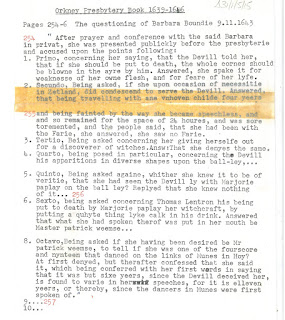
Typed list of questions (Reference: D31/1/5/15)

Original presbytery minute book (Reference: OCR/4/1)

Albert Thomson's Collection (D66)
Albert Thomson was curator of St Magnus Cathedral for 32 years from 1946 until his retirement in 1978. His collection is made up of archive items collected by him and notes made by him. This is a single page original document of a woman accused of witchcraft in 1679.
Evidence from John Mowatt and John Flett against Margaret Sclater,
accusing her of witchcraft, Firth Parish 1679. (Ref: D66/1/19)
This is a transcription presumably by Mr Thomson himself. (Ref: D66/1/19)
 

SC11 - Orkney Sheriff Court Records
The Sheriff was a royal official appointed to help the monarch establish control in the localities. Sheriff performed a wide variety of duties, administrative, financial, military as well as judicial. Judicially, the sheriffs dealt with both civil and criminal cases and appeals as well as first time cases. Our collection is held in the Orkney Archive under Charge and Superintendence from the National Records of Scotland.

SC11/5 - Civil Court Processes

SC11/5/1646/010 - Janet/Jonet Rendall in Rigga. Indicted for Witchcraft in 1646
SC11/5/1646/010 Trial of Janet Rendall page 1

SC11/5/1646/010 Trial of Janet Rendall page 2

SC11/5/1646/010 Trial of Janet Rendall page 3
The indictment of Jonet Rendall in Rigga, in the parish of Rendall is catalogued as part of the Civil Court Processes Collection. Unfortunately a transcription for this document is not in the Orkney Archive collections. It is also extremely fragile.

[Update: The Orkney Archive Palaeography Group took on the task of transcribing the above document. We went home having successfully transcribed 27 lines. Two of us came back to the Group with the discovery that this document has been transcribed before. Two sources have it: one Kirkwall in the Orkneys  by Hossack on pp256-258; and the other County Folklore Vol. III Orkney & Shetland Islands collected by G F Black (Facsimile Edition) on pp103-108. Both published transcriptions have the document dated 1629 and as part of the 1629 trial of Janet/Jonet Rendall of Rigga in the parish of Rendall. So, we have not discovered a "new" victim of the witchcraft trials, but we have reversed some incorrect cataloguing. The new reference number for this document is SC11/5/1629/41. We are also looking into getting the document some professional tlc.]

SC11/79 Miscellanea - Transcripts of documents deposited in H. M. Register House (Now National Records of Scotland) by George H. M. Thoms, Sheriff of Orkney and Shetland from 1870-1903.

SC11/79/1 - In this book is a transcript of Katherine Grieve's trial from 1633 and also the trial of Janet Rendall of Rigga from 1629 (first three pages shown below). The indictment document mentioned above is not transcribed here.

SC11/79/1 - Trial of Janet Rigga page 271

SC11/79/1 - Trial of Janet Rigga page 272

SC11/79/1 - Trial of Janet Rigga page 273

Joseph Storer Clouston Collection [D23]
J. Storer Cluston OBE, FSA Scot, JP 1870-1944, was a novelist, historian, antiquarian and chairman of the Orkney Antiquarian Society. He wrote "A History of Orkney" in 1932.
D23/14/8 - Indictment for "witchcraft, sorcerie and divining" of Helen Isbister, vagabond, 1635. There is no transcription available for this document in the Orkney Archive. It is written in Secretary Script which uses different letter forms than we use now. A useful web source for learning to read this script is Scotland's People's handwriting page here
D23/14/8 - Indictment of Helen Isbister, page 1

D23/4/8 - Indictment for Helen Isbister, page 2

D23/14/8 - Indictment for Helen Isbister, page 3

John Mooney Collection [D49]
John Mooney, 1862-1950, was a reporter on the 'Orkney and Shetland Telegraph' for a brief time, then in 1884 joined R. Garden Ltd, general merchant. He was a keen historian and a founder member of the Orkney Antiquarian Society. He published various publications concerning the history of Orkney.

D49/3/12 - A reference in John Mooney's collection leads to a single page entry in the 1913 Peace's Almanac regarding Katherine Grieve.


D49/3/12 Katherine Grieve, an Evie Witch p152-153
A set of Peace's Almanacs from 1868-1940 is available to see in the Orkney Room stored with the Periodicals under reference 914.1 YZ.

Published Sources in the Orkney Room
Abbotsford Club Miscellany Trials for Witchcraft, Sorcery and Superstition in Orkney contains:
The trial of Marable Couper for witchcraft, sorcery and superstition, 1624
The trial of Annie Tailzeour [Taylor] alias Rwna Rowa for witchcraft, sorcery and superstition, 1624
Examination of the Charges of Witchcraft and Sorcery against Marione Richart or Layland before the Kirk Session of Sanday, 1633. The trial of Marione Richart, alias Layland for witchcraft, sorcery and divination, 1633.
The trial of Katherine Craigie, alias Estquoy, for witchcraft, sorcery and superstition, 1640. Second trial of Katherine Craigie, 1643.
[Orkney Room Reference 133.4Y]

County Folklore Volume III - Orkney and Shetland Islands - Contains the Trial of Janet Forsyth accused of witchcraft. [Orkney Room Reference 390 YZ]
Witch Stories - A collection of stories about witches and witchcraft in Scotland. Contains references to Orkney witches Margaret Balfour, Alison Balfour, Katherine Grant, Marion Richart, Elspeth Cursiter, Janet Rendall, Janet Forsyth, Katherine Grieve, John Sinclair, Bessie Skebister, Catherine Craigie, James Knarston, Marion Comloquoy and Catherine Taylor. [Orkney Room Reference 398]
The Darker Superstitions of Scotland - includes many references to Orkney witches and witchcraft. Alison Balfour, Margaret Balfour, Katherine Bigland, Katherine Caray, David Comloquoy, Marion Comloquoy, Thomas Corse, Marable Couper, Katherine Craigie, Elspeth Cursiter, James Daill, John Faw, Janet Forsyth, Christian Gow, Katherine Grant, William Gude, James Hourston, Helen Hunter, Janet Irving, Helen Isbister, Alexander Knarston, Cirstane Leask, Oliver Leask, Magnus Linay, Christian Marwick, John Master, Katherine Miller, Janet Rendall, Elspeth Reoch, Marion Richart, Margaret Sandison, Geillis Sclater, Agnes Scottie, William Scottie, Isobel Sinclair, Janet Sinclair, John Sinclair, Bessie Skebister, Annie Taylor, Janet Thomson, Agnes Tulloch and Helen Wallis. [Orkney Room Reference 398]

Other Published Sources in the Orkney Room
133.4: General Scottish books
which mention Orkney witches and witchcraft trials
133.4 Y: Specific Orkney books
which are mainly about Orkney witches and witchcraft trials.
398 and 390 YZ: Folklore books which include stories
about Orkney and Shetland witches.


This is a selection of the sources available on this subject, not our complete list, but hopefully it gives you an idea of what we have.

This list was requested by the group dedicated to unveiling a memorial to the victims of the Orkney witchcraft trials. On 30 October 2018 they held a creative day to gather items to add to a time capsule which was to be buried underneath the memorial. On 9th March 2019 they successfully unveiled the memorial at Gallowha in Kirkwall where many of the victims were executed. More information can be found here and here